A common source of frustration for the puppy or newly-adopted dog owner, let’s simplify potty-training!
Potty training, house-training, the traditional term “housebreaking…” It’s all the same thing, isn’t it? It means teaching new puppy (or dog) – we’ll call him Bellhop for the purposes of this article – to eliminate in some places, and not to eliminate in others.
As a general rule of thumb, you can assess that your puppy can probably “hold it” for the number of months old he is, divided by two. (So a two month old puppy can probably only hold it for about an hour.) Individual puppies deviate from this norm, and smaller puppies have to go more frequently than large. (I think that’s why the Littles get the undeserved bad rap when it comes to house-training.) An exception to this general rule is during the night; you need not be up every hour on the hour.
During Bellhop’s waking hours, supervision is critical. Freedom should be earned through reliability. Bellhop cannot have that kind of reliability for you when he is this young – under six months. For this reason, you keep him under your watchful eye. He just hasn’t been on the planet long enough to show you months of reliability with much of anything. For this reason, he should not be in one room free while you are in another. There is a lot of “two steps forward, one step back” at this stage. For this reason, you should be minimizing the hiccups by not giving Bellhop more freedom than he can handle. This is because anything – and I do mean anything – practiced gets easier to do, whether you want it to or not. Peeing on the carpet gets easier; so does peeing outside. Set your pup up for success by supervising – or safely containing B when you can’t watch him.
Supervision & Containment Suggestions:
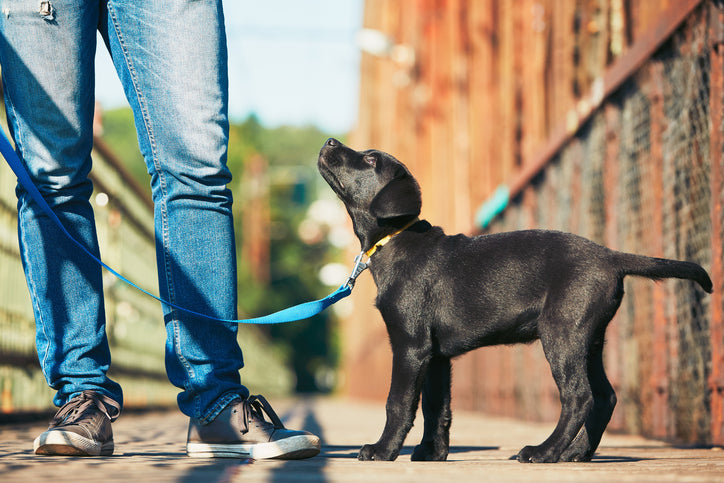
- Tether Bellhop to your belt with a leash
- Accustom Bellhop to being outside on a tether if your property allows
-
Crate train – crate should be large enough for Bellhop to stand up, turn around, and lay down… but not much bigger
- X pens are awesome tools for keeping puppies contained and they are frequently available on yard sale sites or craigslist
If your eyes cannot be on the puppy, then your puppy should be safely contained somehow. This is so you can take control of his bathroom habits, among other things. Safety reasons also abound.
Schedule Bellhop’s feedings. What goes in on schedule comes out on schedule. You can’t predict the output if you don’t know the input! With a teeny bit of tough love, you can get puppy on a feeding schedule in a matter of days. Divide his daily food ration into two or three (possibly even four for very young or small breed puppies – consult your vet if you are unsure). Try to have Bellhop work up a bit of an appetite by first taking him out to potty and giving him some special attention before breakfast. When these things are done, offer him his measured food in a bowl on the floor. Leave it available for 15 – 20 minutes. Whether it is eaten or not at the end of that 20 minutes, pick it up and do not offer again until his next scheduled feeding time.
Do not fret about feeding times being off by an hour or more daily. Adaptability is a good thing and will not cause physical harm, baring a pre-existing medical condition. Just remember that the more consistently you feed, the more consistently Bellhop poops and pees.
The type of food your dog eats has a lot to do with how much he goes to the bathroom. Kibble with lots of filler – soy, corn, various other grains, artificial colors and flavors – means more waste. The protein content of your individual pup’s food is something you may want to research or speak to a pro about. (For example, certain dogs and puppies do not do well with very high protein diets and will poop many more times a day than if they were on a lower protein food.)
***For Poop-Eaters***
There could be a health reason your dog is snacking on his or other dogs’ dumps. His diet could be low in vitamins or certain minerals. Consider upgrading Bellhop’s kibble and/or consult your vet. You can also try one of these home remedies: adding a little raw pumpkin or pineapple to his food – tastes good on the way in, not so much on the way out is the theory. Gain a really good “leave it” command as quick as you can and administer as soon as Bellhop has gone to the bathroom. To do this, yes – you’ll have to be outside with him (or inside with an e collar remote), which brings me to…
Walk B outside on a leash as opposed to just opening the door and letting him out to potty. Here’s why: walking him out on a leash will ensure that you will be there to offer than extra reinforcement – verbal praise and maybe even a cookie you have brought out with you. Part of the “positive reinforcement” of eliminating (going pee or poo) is the physical relief that comes with the go! No treat or verbal praise necessary for reinforcement of the behavior to occur. THAT’S why it’s so important to SUPERVISE, SUPERVISE, SUPERVISE and/or CONTAIN, CONTAIN, CONTAIN while you are achieving house-training success! Because… everything practiced gets easier to do!
When you walk Bellhop outside, do not do circles and circles around the yard. Designate the Potty Spot and on your schedule – we will finetune that in just a paragraph – bring Bellhop outside to the Potty Spot and be a post. That means do not move. Hold the leash and twist with your puppy, but keep your feet in the same imaginary little box. Be very boring and quiet and do not give Bellhop anything interesting to pay attention to on your part. When Bellhop finally squats, give calm encouragement and assign your “potty word.” A “potty word” is a simple cue that you can use to teach B to eliminate on cue. Useful for traveling and any other time you bring Bellhop off your property. As he’s letting it go at the Potty Spot, quietly say “gooooood boy.. gooooood hurry-ups” – or whatever other term you want to use. (I say “Concentrate.” Gets a laugh.)
You can count on puppy having to go outside any time he:
- Wakes up (nighttime or nap)
- Eats or drinks
- During times of high activity (visitors, family affairs) or excitement (greeting kids)
- Divide the number of months old puppy is by two – works up to 12 months. This is about how long he can hold it, all other things being equal. ***NOTE*** In case common sense does not slap you across the face, this is not scientific and every puppy is an individual. There also may be size or breed factors to consider.
If your puppy pees in his crate:
-
Make sure you are not leaving him in there for longer than he can physically hold it – besides being cruel, this causes desensitization and bad habits to form that are potentially difficult to repair later
- Rule out medical issues by having a full exam by a good vet. Do not make assumptions. (Urinary tract infections can occur in either sex and may manifest as house-training issues when the issue is in fact medical.)
-
Try taking out absorbent surfaces from the crate – yes, this may mean Bellhop’s in a naked crate. This is a reality due to safety concerns for puppies & dogs who shred & swallow bedding as well.
-
Some puppies have ingrained poor potty manners because of the environment in which they were housed or raised. If you have the rare puppy who pees/poos in his crate and lays in it and seems to think nothing of it, here is what I suggest (as I had to do with one of my personal dogs – a certain red American pit bull terrier named Spark Plug who was taken from his litter too soon, which can affect house-training): get an X pen and make it small enough to fit Bellhop’s crate in it with a little space left over. Put his bed in the crate or even better, a shirt that smells like family, and open the door of the crate inside the X pen. Have the crate open onto a small section of puppy pads (or litter box, something suitable for bathroom material). You are giving Puppy two options: Poop where you lay ***OR*** Poop NOT where you lay. In this way, you can develop the habit of keeping his bed clean – a natural inclination of which he may have been robbed in his previous environment. It is not Bellhop’s fault – you can be sure of that.
Remember that if you are adopting an older dog that comes house-trained, he may well have been house-trained – to that house and that routine. You will likely have to guide him through these new rules in this new place. Consider yourself his coach.
On that note, if Bellhop is only having accidents in one room or area of the house, cordon off that area. He should not be allowed in there whatsoever at this stage unless supervised by you. Take him into the forbidden rooms and PRACTICE TRAINING. Do a little sit, down, sit or play with toys with him. Bring him room to room and show him that they are all part of the den and not meant to be used as his personal bathroom.
If at any time – since you’re supervising Puppy all the time now, riiiiiiight??? – you catch Bellhop in the act – lifting a leg or bending over to drop a deuce – make a crazy loud sound. Act like you momentarily lost your mind to interrupt him, then scoop him up or rush him to the nearest exit. Hopefully he finishes when you have air-lifted him to his Potty Spot outside. If so, reward, remembering the reward does not have to be food all the time.
You may choose to teach Bellhop to ring a bell to tell you he has to go out! How brilliant.
Here are the steps:
-
Purchase bells and hang on the inside door knob of the door(s) you would like to use primarily for “outs” – as we affectionately call them in the boarding kennel.
- Each time you are about to bring Bellhop out to BM (Bowel Movement) or pee, see if you can get him to make the bells ring. (I used a dab of peanut butter or cheese wiz to elicit this behavior. You could also teach and utilize the “touch” cue here.)
-
Bell rings, door magically opens! Immediately. And out you go to the Potty Spot. Big party when he completes the sequence!
-
Your dog can absolutely learn to ring the bell to get your attention. As B becomes more proficient in communicating to you that he needs to “go out,” try to just take him out when he’s “serious” – which you will be able to distinguish by his furious whacking the bell and running back ‘n forth between you and the door. He could certainly pick up on the fact that you jump every time he rings the bell. Some dogs have their bells taken away from them once they are housetrained for this reason! EH-HEM, Spark Plug…
If you have a lot of family members responsible for the care of the dog, make a chart with Bellhop’s feeding and going out times. (A white board with check boxes works well.) Miscommunication between family members never bodes well for Bellhop’s house-training…
You may consider leaving Bellhop a frozen water bowl or some ice cubes overnight instead of a big bowl of water. Water bottles (like big versions of the kind given to Guinea pigs) are also available for crates and/or X pens and can save a lot of mess and wet bedding – get B to try one by putting a dab of coconut oil on the nozzle.
More frequent smaller meals are generally better than infrequent large ones.
Many dogs need to work up an appetite before they want to eat. Do not worry about feeding breakfast at a certain time if your dog is of this variety. Simply feed him post-exercise. It will make perfect primal sense to him.
Did you know?
- There is a device called a Pee Post that can be very effective for teaching dogs where to go outside – especially leg-lifting males or marking females
- For truly difficult males, there is something called a Belly Band that deters some dogs from trying to pee while wearing it. There exists a diaper similar for females.
-
There are many medical conditions for which abnormal elimination is a symptom – always get a clean bill of health from your vet and do not be afraid to get second opinions
-
Litter boxes can be reasonably clean & effective Potty Spots for small dogs left alone longer than they can physically hold it
- Many people have success clicker training their puppies and adult dogs to go potty outside! Pick a clicker up at any pet supply store and load it. Load the clicker means 1 click = 1 treat. Your pup will soon associate the click sound with a treat. Now you can use the clicker as a non-emotional sound to mark the instant your pup has done something to earn himself a treat, i.e. click when he finishes his pee outside, and deliver the treat! Wah-lah! You are clicker training house-training manners.
For the most “stubborn” cases:
- Take dog from crate to outside multiple times throughout the day and heavily reinforce only the going to the bathroom outside. Crate. Potty Spot. Crate. Potty Spot. That’s it for your whole weekend until B’s getting the message. Also probably a good time to seek out a professional.
In short, the responsibility of teaching Bellhop house-training manners falls on his people. We have this gorgeous canine counterpart we have adopted to live in a civilized human society. Sometimes we take for granted their willingness to learn & roll along with all of our daily expectations. Remember to be patient and importantly, be sincere in your praise.
Thank you for reading, and visit hexdogs.com to learn more about the author.

Cassie-Leigh Stock, ABCDT, CTDI, AKC-CGC, CDT, All-Star TC
My name is Cassie-Leigh Stock, Massachusetts-native and founder of HEX Dog Training & Behavior Modification, headquartered in Mendon. I also manage the boarding kennel at a Franklin animal hospital. I trained for a large corporate chain for six years, and spent two of those years as an Area Pet Training Instructor, teaching dog training classes as well as training trainers. It was a complete pleasure, and I loved my time there, although I began to feel the desire to further spread my wings. As I become more immersed in the craft and continued to further my education, eventually it was time to part ways with the big box store in order to pursue what had become my dream, and start my own dog training company. That is where HEX was born. HEX is short for Higher Expectations, and I specialize in pit bulls and group class instruction.
My inspiration for my entire career, and in one form or another, my life, is my American pit bull terrier, Spark Plug. He was my first pit bull, and he came to me from a shelter in Rhode Island when he was about five weeks old. I was hooked on bully breeds after that, and that reflects in my multi-dog home. I love this occupation as much as the day I started, and this July I will celebrate my ten year anniversary of professional dog training accreditation. My credentials include: Canine Good Citizen evaluator, certified through Animal Behavior College, and Certified Trick Dog Instructor. Other interests include reading, writing, hiking, training and recently… painting.